
SPX-001 : Pioneering the Future of Respiratory Infection Treatment
The Respiratory Infection Challenge
Respiratory infections remain among the most significant threats to global health. Hospital-acquired pneumonia (HAP) and ventilator-associated pneumonia (VAP) affect thousands of critically ill patients annually, with mortality rates ranging from 20-50% despite aggressive antibiotic therapy. The challenge isn’t just the severity of these infections—it’s the unique environment of the respiratory tract that renders many treatments ineffective.
The lungs present a hostile environment for antimicrobial therapy. Thick mucus, abundant blood serum proteins, inflammatory cells, and cellular debris create conditions that dramatically reduce the efficacy of conventional antimicrobials. Traditional hypochlorous acid (HOCl) formulations, despite potent antimicrobial activity in laboratory settings, lose most of their effectiveness when confronted with the complex biochemistry of infected lungs.
This is where innovation becomes imperative. Enter SPX-001: a next-generation antimicrobial drug candidate specifically engineered to overcome the limitations that have prevented effective pulmonary infection treatment.
SPX-001: Engineering Solutions for Pulmonary Challenges
SPX-001 represents a fundamental rethinking of antimicrobial therapy for respiratory infections. Building on proven SPC-069 chemistry, this broad-spectrum antiviral and antibacterial drug candidate addresses the primary factor that limits conventional HOCl efficacy: stability and activity in the presence of serum and biological fluids.
The Serum Stability Breakthrough
The development team behind SPX-001 identified a critical weakness in traditional antimicrobial approaches: most lose potency when exposed to proteins found in blood and bodily fluids. In infected lungs, where inflammation brings serum proteins into the airway lining fluid, this limitation proves devastating.
SPX-001 maintains antimicrobial activity in 5% serum—a concentration that completely inactivates conventional HOCl products. This isn’t a marginal improvement; it’s the difference between therapeutic success and failure in real-world clinical conditions.
Mucus Penetration
Respiratory infections generate thick, viscous mucus that serves as both a physical barrier and a haven for pathogens. SPX-001’s formulation enables penetration through mucus layers, reaching bacteria and viruses that hide beneath this protective coating. This capability addresses one of the fundamental challenges in treating chronic respiratory infections, particularly in conditions like cystic fibrosis where thick mucus perpetuates infections.
The Science Behind SPX-001
Understanding SPX-001’s mechanism reveals why it succeeds where other approaches fail:
Broad-Spectrum Activity
Unlike narrow-spectrum antibiotics that target specific bacterial classes, SPX-001 demonstrates efficacy against:
- Gram-positive bacteria (including MRSA)
- Gram-negative bacteria (including Pseudomonas aeruginosa)
- Viral respiratory pathogens
- Fungal pathogens
This broad coverage is particularly valuable in critically ill patients where mixed infections are common and rapid empiric treatment is essential.
Rapid Action
SPX-001’s antimicrobial effect occurs within minutes, not hours or days. This rapid action prevents bacterial proliferation during the critical early phase of infection when pathogen loads are still manageable and before biofilms can establish.
No Resistance Promotion
Perhaps most critically, SPX-001’s multi-target mechanism makes resistance development extraordinarily unlikely. As discussed in recent research on HOCl-based therapies, the simultaneous disruption of multiple cellular components—membranes, proteins, nucleic acids—requires bacteria to develop multiple resistance mechanisms simultaneously, an evolutionary near-impossibility.
Target Indications: Where SPX-001 Excels
Hospital-Acquired Pneumonia (HAP)
HAP affects 0.5-2% of hospitalized patients and carries mortality rates of 20-50%. Current treatment relies heavily on broad-spectrum antibiotics, contributing to resistance development. SPX-001 offers an alternative that maintains efficacy against resistant strains while avoiding resistance promotion.
Ventilator-Associated Pneumonia (VAP)
VAP develops in 9-27% of mechanically ventilated patients, typically caused by bacteria that colonize the oropharynx and are aspirated into the lungs. The presence of endotracheal tubes and breathing circuits creates biofilm-prone surfaces, and accumulated secretions provide ideal conditions for infection.
SPX-001’s ability to penetrate mucus, maintain activity in serum, and disrupt biofilms positions it as an ideal candidate for VAP prevention and treatment delivered directly through ventilator circuits.
Chronic Respiratory Infections
Patients with chronic lung diseases like cystic fibrosis, bronchiectasis, or chronic obstructive pulmonary disease (COPD) experience repeated respiratory infections that progressively damage lung tissue. The biofilm-forming capabilities of pathogens like Pseudomonas aeruginosa make these infections particularly difficult to eradicate.
Delivery Method: Direct to the Lungs
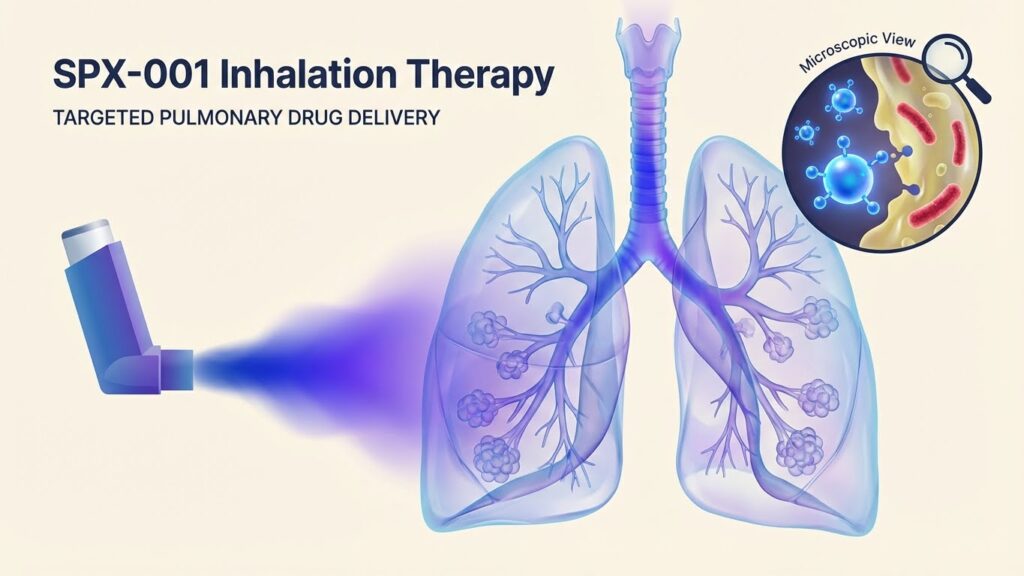
SPX-001 is designed for inhalation delivery, allowing direct application to infection sites. This approach offers several advantages:
Targeted Therapy Delivering antimicrobials directly to the lungs achieves high local concentrations at infection sites while minimizing systemic exposure. This targeted approach reduces potential side effects and drug interactions.
Bypassing Serum Limitations While systemic antibiotics must penetrate from the bloodstream through lung tissue into airways (with significant loss of activity along the way), inhaled SPX-001 delivers therapeutic concentrations directly where needed.
Rapid Response Inhalation allows immediate contact with pathogens, initiating antimicrobial action within minutes rather than waiting for systemic absorption and distribution.
Patient Convenience Nebulizer or inhaler delivery is familiar to respiratory patients and can be administered in hospital or potentially home settings, improving treatment accessibility.
The Development Journey
Preclinical Optimization
Current development focuses on refining formulation parameters:
- Optimal concentration for nebulization
- Particle size distribution for deep lung penetration
- Stability in nebulizer reservoirs
- Compatibility with standard nebulizer equipment
Preclinical studies evaluate:
- Antimicrobial efficacy against common respiratory pathogens
- Tissue penetration and distribution
- Safety and tolerability in respiratory tissues
- Pharmacokinetic/pharmacodynamic relationships
Strategic Partnership: SpectrumX
Recognition of SPX-001’s potential led to a significant development milestone: licensing to SpectrumX for UK and European markets. This partnership:
- Validates SPX-001’s commercial potential
- Accelerates development through shared resources and expertise
- Positions the therapy for regulatory pathways in multiple markets
- Demonstrates confidence from experienced pharmaceutical partners
The Regulatory Pathway Forward
SPX-001’s development follows established regulatory frameworks for new antimicrobial drug approval:
Investigational New Drug (IND) Application This critical step enables human clinical trials, requiring comprehensive preclinical data on:
- Manufacturing and quality control
- Animal safety studies
- Proposed clinical trial protocols
- Rationale for dose selection
Phase 1 Clinical Trials Initial human studies will evaluate:
- Safety and tolerability in healthy volunteers
- Pharmacokinetics (how the body processes SPX-001)
- Dose-ranging for optimal efficacy-to-safety ratio
- Single and multiple-dose effects
Phase 2 Clinical Trials Proof-of-concept studies in patients with respiratory infections will assess:
- Preliminary efficacy against target pathogens
- Clinical improvement metrics (symptoms, oxygenation, imaging)
- Optimal dosing regimens
- Safety in infected populations
Phase 3 Clinical Trials Large-scale trials will provide:
- Definitive efficacy data versus standard of care
- Safety profile in diverse patient populations
- Data supporting specific indication claims
- Post-marketing surveillance plans
The Unmet Need SPX-001 Addresses
Current respiratory infection treatment faces multiple challenges:
Antibiotic Resistance Increasing rates of multidrug-resistant respiratory pathogens limit treatment options. When first-line antibiotics fail, clinicians must resort to toxic second-line agents with significant side effects.
Treatment Failures Even with appropriate antibiotic selection, penetration into infected lung tissue often proves inadequate. Biofilms, mucus plugging, and serum protein binding reduce efficacy.
Limited Viral Options While bacterial pneumonias have multiple antibiotic options (albeit increasingly resistant), viral respiratory infections have few targeted treatments. SPX-001’s antiviral activity addresses this gap.
Safety Concerns Systemic antibiotics carry risks of organ toxicity, drug interactions, and disruption of normal microbiota. Topical pulmonary delivery of SPX-001 minimizes these concerns.
Competitive Advantages
SPX-001 distinguishes itself from existing and emerging respiratory antimicrobials:
Versus Conventional Antibiotics:
- No resistance development
- Effective against resistant strains
- Dual antibacterial/antiviral activity
- Minimal systemic effects
Versus Other Topical Antimicrobials:
- Maintains activity in serum and mucus
- Superior biofilm penetration
- Rapid onset of action
- Favorable safety profile
Versus Antiseptic Inhalations:
- Stable formulation
- Defined therapeutic concentration
- Controlled delivery
- Pharmaceutical-grade quality
Looking Ahead: The Clinical Future
Success of SPX-001 in clinical development could transform respiratory infection management:
ICU Applications Preventing and treating VAP in critically ill patients, reducing ventilator days and improving survival.
Chronic Lung Disease Managing chronic infections in cystic fibrosis and bronchiectasis patients, potentially reducing exacerbations and preserving lung function.
Outbreak Response Rapid deployment during respiratory viral pandemics, offering both treatment and prophylaxis options.
Antibiotic Stewardship Reducing reliance on systemic antibiotics, helping preserve their effectiveness for other infections.
The Path to Patients
While significant development work remains, SPX-001’s unique properties position it to address critical unmet needs in respiratory infection management. The combination of proven HOCl antimicrobial chemistry, engineering innovations that overcome traditional limitations, and strategic partnerships creates a strong foundation for clinical success.
For patients suffering from difficult-to-treat respiratory infections, for clinicians frustrated by treatment limitations, and for healthcare systems battling rising resistance rates, SPX-001 represents genuine hope—hope backed by solid science and thoughtful development.
Conclusion
Respiratory infections will remain a significant healthcare challenge, but SPX-001 demonstrates that innovation can overcome even the most daunting obstacles. By engineering antimicrobial therapy specifically for the unique environment of infected lungs, addressing the serum and mucus limitations that defeat conventional approaches, and advancing through rigorous development pathways, SPX-001 is pioneering a new frontier in pulmonary medicine.
The journey from laboratory concept to approved therapy is long and demanding, but for the patients who need better options, that journey is worth every step.
Really appreciate the effort behind this post.